On Mother's Day, Brigid Asks Us to Consider the Caregivers in Our Lives
On mothers, writing, and not saying "yes" to everything.

It’s Mother’s Day, which isn’t a difficult day for me per se. I didn’t even realize that it was this weekend until social media told me. But in the interest of full disclosure, it’s a day I don’t put a whole lot of emphasis on in my own life because my relationship with my mother is estranged after a lifetime of enmeshment. Even so, I do tend to write about mothers a lot, about caregiving, about my own lack when it comes to having children of my own. This is why I wrote “Swamp Caoin,” my debut poem in Fish Girl Collective’s (formerly Sardine Can Collective) Bruised Knees and Gardenias anthology on childhood.
I have been waiting to gush about it for months. I wrote this poem in an almost prophetic state. It began as a very real dream I had before receiving family news. I wanted to take an actual moment in time, a humorous one that I actually spent with my young niece, and use it to process the myriad emotions I feel about my large Southern family—most of whom I don’t speak to, whether it be the nature of having such a wide age gap between myself and my siblings, or the frankly abusive ways in which I have been treated, or anger and grief watching the generational trauma cycles repeat themselves.
I am one of five children. More if you count the various step- and half-siblings across the board. But for the most part we always considered us five from our mother (my two brothers, two sisters, and myself) The Five. My younger sister and I are two years apart, while the others are between 6-18 years apart from the two of us. I had my first nephew before I reached first grade.
And while my mother took three of us younger girls out of the house, by the time I reached high school I had three little brothers, not nephews. We watched them nearly every day, from dawn until late at night for some. They got to take home my toys if they cried. They tortured my cats and then I would get the threats of them getting sent to the shelter. My nephews were babies, but the problem was so was I. I’m grown now, though, and can enjoy children a lot more than I could when I was a child also competing fiercely for attention and care. The problem now is my estrangement, which I can’t fix because it’s for my own emotional safety.
That doesn’t change that I have many complicated feelings surrounding being an aunt to many, but friend to none. So this poem comes out of that, of ag caoineadh, of lamenting relationships that are just out of reach, especially to those young girls in my line that I have never had the privilege to really know.
Because of the deeply personal nature of some of my poetry, I am nervous about the reception of the piece. In fact, I don’t think much of my family knows it’s out, which is a shame because I’m proud of it. But I can't be responsible for its reception or lack thereof. I have no control over that part and I don't care to. That reactionary fear comes from a place where I still long to be accepted, but probably will never be. They don't understand me and I don't understand them. I've made peace with that.
Regardless, this is my first publication since graduating with a writing BFA (in fiction no less!). To have my first publication be poetry is something that shocks both the present-day Sam and Sam of the Past, but I've found it's been the only way to express the breadth of these feelings.
The last year has been spent writing and submitting wherever I can, and while I’ve been handed a lot of rejections, this acceptance has been vindicating—that maybe I didn’t waste a bunch of money on a fancy degree, that I can write, and that while this path has been difficult, it has been rewarding. Most importantly, my emotional processing is healing for me. I can’t heal others, especially if they don’t want to be healed, but maybe I can point to something I’ve put in the world and say, “I think about you all the fucking time and I know it’s hard.” That’s the Brigid way, isn’t it? Healing through creation?
You can read “Swamp Caoin” and all of Bruised Knees and Gardenias for free online, but Fish Girl is a wonderful publication that supports raw work, which was why I knew “Swamp Caoin” would be a good fit for it—It’s all raw grief. Bruised Knees and Gardenias is also available in print for sale here and I highly encourage you all to get a copy. It’s an amazing collection and I’m so honored to be a part of it.
If you also write about mothers, caregiving, the family, etc. Lit Match Collective is hosting a public masterclass this month with Editor Autumn Watts called "Unmothering." Full disclosure, I'm a social media associate over at LMC, but their courses and offerings are amazing and are accessible for any level of writer. We're offering a lot to the public so you can try out our services, so take advantage! You can access the public discord link through instagram here.
Oracal ó Bhríd
Oracle from Brigid
I pulled this card with intention and it is a message for some of you, especially the mothers and the caregivers. The Volunteer card depicts the 19 Brigidine Sisters, who would tend the eternal flame of St. Brigid in Cill Dara. This practice is still continued today. According to Moon Mná, the group which this deck comes from, “the number of fire-tending maidens in Brigid’s Fire Temple mirrored the Metonic Moon cycle – a period of 19 years, after which the lunar phases recur at the same time.” (If you need help understanding what that means like I did—it’s the cycle which a phase of the moon occurs at the same time 19 years apart.)
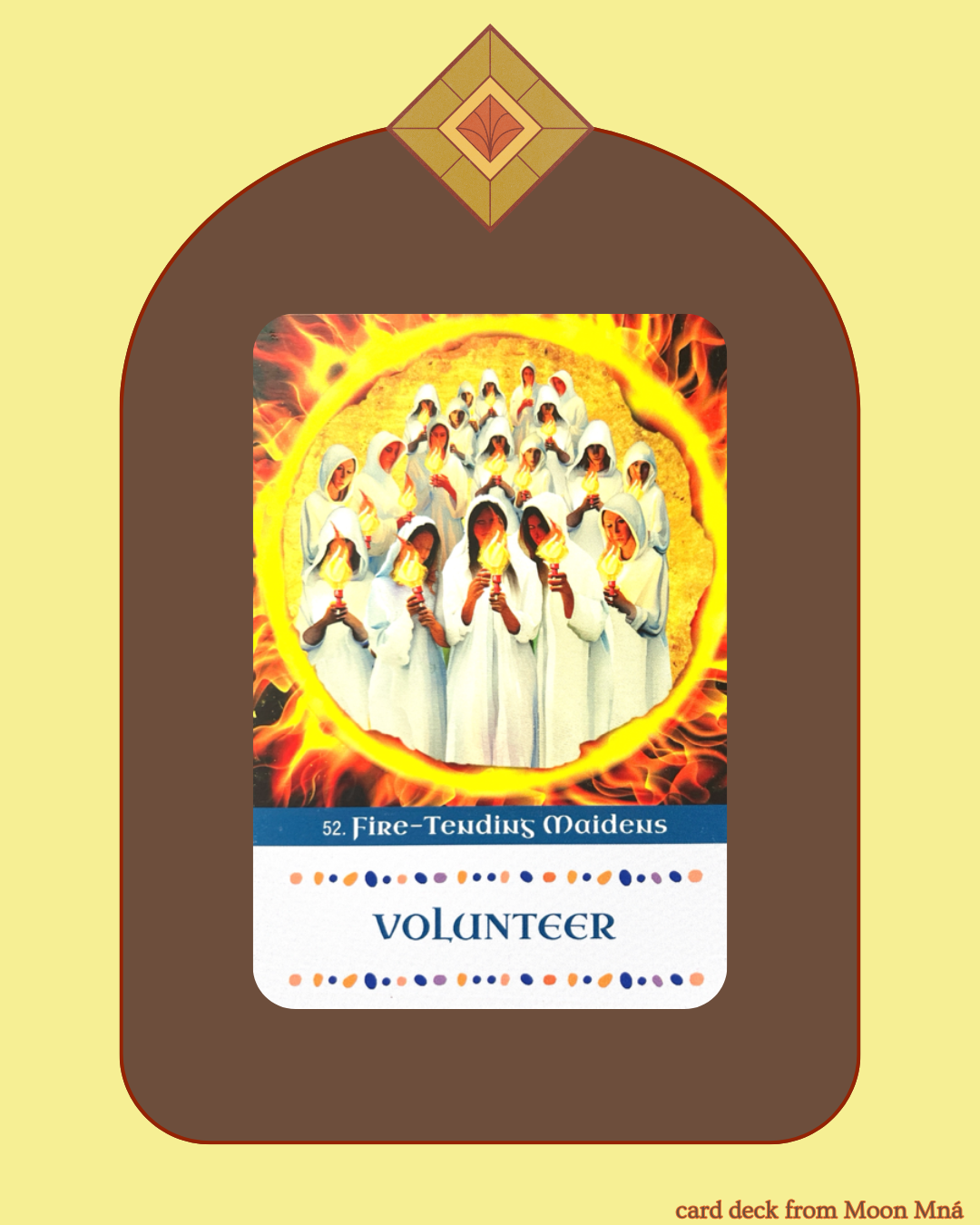
The important part of this message is that it jumped from my hand and in reverse, meaning there is a blockage here. For those of you who may not be caregivers, but maybe you’re near them (your partners, your parents, your friends with children): How have you been of service to those who give care lately? Are you doing all you can to give them aid? It takes a village after all.
For you forever-caregivers: Are you of too much service to others—approaching burnout that can leave lasting damage to you and around you? Take it from someone who worked in the nonprofit sector for a decade: Rest is important as well. If you spend most of your time helping others, rushing in to fix problems, or finding that you have too many balls in the air, it’s time to take a beat. Who can you call on when the load becomes too much to bear alone?
“But Sam if I don’t do it, who will?”
Trust I have heard this voice as well, and you cannot pour from an empty cup. As organizer and craftivist Shannon Downey says in her book Let’s Move the Needle, being realistic about our capacity and figuring out who else we can pull in to help us is part of the work. As I said, it takes a village. Ask for help. The 19 fire-tending maidens, even St. Brigid herself, could not tend the eternal flame alone.
Grá Mór,
Sam
P.S. Paid members be on the look out this week for a long-awaited offering recipe!
Who Gives a Focal is a reader-supported publication, which cannot exist without readers like you. We are just getting started and would love for you to support us in our trial months today if you like what we do.