Dolly Parton Proved That Storytelling Is the Great Unifier
We lost one of the greatest storytellers of all time. How can writers carry the torch?

On the day Dolly Parton died, our AC decided to also cease living while it was over 100 degrees Fahrenheit. Just the night before, a friend called me to ask to borrow our evaporative cooling fans because his AC died, and I gave them away happily, telling the friend that he and his wife were welcome to pack the cats up and stay cool in our house. Oh I should’ve knocked on some wood.
It didn’t get bad until my wife and I went out to lunch. When we came back home, the heat of our west-facing house baking in the Texas afternoon made my face explode in a river of mucus and my brain swelled in my skull. Misery.
When the announcement came the day after, I was alone in another friend’s house. He insisted we load our own cats up and stay with him. I was hesitant because while extremely hospitable, this man’s house is immaculate and my cats are menaces to society. But he assured me that during the Big Freeze of 2021, he hosted a total of eight people, including himself, a dog, four cats, and three chickens, when his was the only home with heating and running water. I remembered that even my wife and I had stolen away for an hour to shower at his place. I don’t remember the chickens.
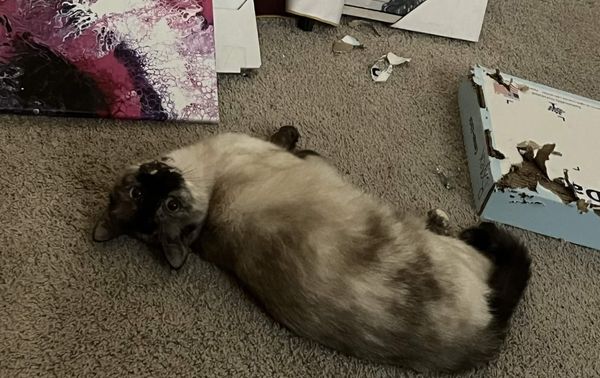
With the cats sequestered by a rickety pet gate to prevent them from tearing up the couch or counter surfing, I was sitting alone on the sofa with my coffee when the message came through on our group chat: Dolly Parton died. I kept scrolling, as we are all wont to do these days when tragedy is followed immediately by influencer ads, cute animal videos, and whatever other distractions and spectacles we’re exposed to on a daily basis. But soon enough, the tributes rolled in, filling my feed with mourners from all walks: country music celebrities, Dolly's family, fans from across the world. My social cat, Sypha, mewed relentlessly to be set free in this new environment, and in that moment of weakness I did relent to let her sniff around because Dolly fucking Parton died.
Along with the death of Betty White, Dolly’s looming departure from this world was always a distant impossibility on the horizon, clouds of disaster rolling toward us, but never making it to our doorsteps. She was just always on my TV with her giant wigs and rhinestones.
Unlike older folks who might remember Dolly more in her heyday, I remember the Dolly of the early aughts the most, an old woman doing interviews about her illustrious career. I didn't realize she even continued to make music until the last 10 years. (I think the one I remember most was when she did a song with Brad Paisley.) And despite being a country darling, I don’t ever remember any of her newer work getting radio play on 99.9 Kiss Country. You might get a classic like “Jolene,” or “Coat of Many Colors,” on 103.5 Thunder Country, the station that was most reputed as being classic country in my hometown.
The person who invited me to see Dolly in a new light a number of years ago was this very friend who opened his home to me. An NPR-head by nature, he turned me on to “Dolly Parton’s America” hosted by Jad Abumrad, who not only grew up in Tennessee, but had a parent who medically treated Dolly herself. It wasn’t until listening to it that I really understood the place Dolly held, not just in Southern American culture, but to everyone—even literal political prisoners across the globe. The podcast itself does a wonderful job of analyzing the unique place Dolly resides in pop culture, a place no other celebrity, let alone a woman, has ever been able to occupy. In a country divvied up geographically and politically, Dolly Parton has always remained a universal, unifying figure.
In writing school, I was told that the “specific is universal.” In other words, the more specific you can be about a lived experience, the more relatable the writing because someone will always have a somewhat adjacent experience that they can recognize in it. Yes, Dolly Parton specifically sang about the South, a woman’s complicated place in it, and idyllic scenes from the holler, but that didn’t make her music inaccessible to other people by any means. As Abumrad notes, everyone has a Tennessee Mountain Home.
My friend, who hails from Bengaluru originally, and I have always bonded in this way—“Oh your mom does that, too? That’s such an Indian mom thing,” “Did you ever…” We met when we both happened to attend the same movie screening for a local now-defunct production company. He was my very first friend I made when I lived alone in a studio apartment close to the HEB because I didn’t have a car. He gave me his TV when he wanted an upgrade and was always willing to come pick me up just to get me to come to his community anime nights. We were two southern transplants from different countries and we both love living in the South.
It's often a whitewashed cliché to say something like “we’re all one race, the human race,” used to paper over the bigoted horrors we inflict on one another. Sometimes when we write, we want to write a vague universal, philosophical truth over the specific truth. We never want to write the hard thing, but that’s where relatability, vulnerability lives.
Who are any of us to pen sweeping truths without revealing the lived experience that made us recognize those truths? Lived experience can sometimes be the most neutral of ground, where commonality and understanding unify us. Why else do we relate to stories about far off worlds with dragons or to a woman singing about the loss of a child and a man from Dover? Why else do we tell stories if not to relate to each other as human beings?
I neglected my storytelling for over a decade while I worked tirelessly at a career that I believed in. It was nonprofit work and it made me feel like I was helping change the world, even if I was stuck on my living room couch every day. As an editor, I considered what stories we told, what upheld our values, what was a story being ignored in the mainstream. As a copyeditor, I helped to cultivate our style guide so that the language we used to tell those stories wasn't exclusionary. It could get contentious when it came to the oxford comma. Ultimately, 11 years of that work wore me down. I still heartily believe in the work Truthout does in this media hellscape, but I neglected my own ability to tell stories.
That neglect was two-fold: part burnout and part a subconscious idea that while I was putting the impetus on others' real life stories, I began to believe that the ones I could tell held no importance in a world constantly being torn asunder. I've learned how wrong-headed that is. Everyone has a story and everyone has a stake in what happens to this world, how artists will capture the moment, and how that will be important when we imagine what's possible.
When I wrote "Fin de Siècle," it was simply an erotic story. Part of a universe I'm still working to build. It was meant to entertain my friends and collaborators between Dungeons & Dragons sessions. What compelled me most to write it was the parallel experience of the two main characters: Clare and Mr. Lis. Both come from different parts of Europe actively being colonized in 1890. That story is important to tell, especially for the collective memory of American descendants of people like them. A lot of us have forgotten that many of our ancestors were forcibly displaced by hunger, poverty, and war, imposed on them by countries like Russia and England. It's an experience that we've forgotten and find ourselves unable to connect with those experiencing it in Palestine, Ukraine, the Middle East, South America, even in Ireland where harsh economic policies and U.S. intervention continue to force people out of the country.
I think we need stories now more than ever. Not commercial plug-and-play plots to write 50 books a year, not AI slop, not escapism. I see value in the occasional respite, but our minds and our souls crave real human connection and stories. We were meant to share our stories with one another so we don't destroy each other. That's what Dolly's best work did. Even if it wasn't a hit, by the time she died, anything with her name on it could generate the capital to get stories into the hands of children through her Imagination Library.
I wonder what the Dolly really thought of being so universally beloved for this work of hers. Does that kind of sentiment simply become background noise until one day you're starkly reminded of it when your own Kenny Rogers is lending you his power drill so you can take down your attic stairs to install a new AC?
How could she have witnessed so much inside and outside the music industry, so much transformation in one lifetime and make art through it all? One minute you're singing next to Porter Wagoner and the next Slash is doing your guitar riff because you’re Dolly Fucking Parton.
My year has felt a little like that. If I think about where I was last September (panicked, not a literary connection to my name, not a job prospect in the world) and compare it to now, I'm frankly stunned. I went from writing only blips of work to share with friends, to being brave enough to submit to magazines. I got into three this year, a chairde. That's a big deal. And those stories, I hope, are entertaining, but I also hope they contain a kernel of something to take with you. They're dressed up like Dolly in trappings of the supernatural and sparkling fantasy worlds, but I hope you see what's underneath them.
I wish I could be half as good as her, half as deserving, half as selfless, half as kind, half as motivated, and self-assured. More importantly, I hope I can be half the storyteller she was. Maybe we all do.
Slán anois,
Sam
If you want to help an independent news organization stay afloat, please consider subscribing to Truthout today! They are an entirely reader-funded news organization and a union shop. Please consider doing so in the spirit of Dolly's storytelling and philanthropy.
If you are a writer looking for support and community, join us over at Lit Mat Collective today!
Who Gives a Focal is an entirely free and reader-supported publication, which cannot exist without readers like you. Consider subscribing or purchasing some of my published work to support me and storytellers like me.